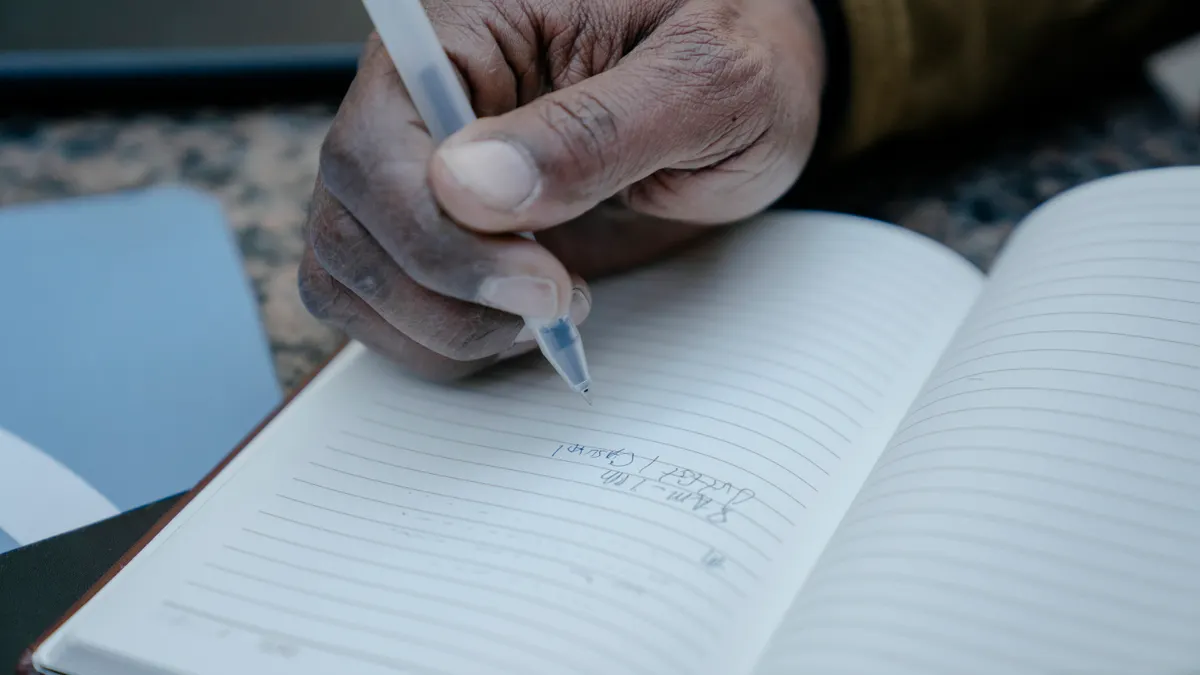
How to Make Journaling a Daily Habit
Last updated: October 10, 2026
Key Takeaways
- Journaling works best when the cue, format, and time slot stay predictable.
- Choose one exact moment, container, and minimum to start.
- Write for tomorrow’s usefulness, not tonight’s brilliance.
- Make the minimum tiny enough that resistance has little to fight.
Journaling becomes a daily habit when you make it small enough to start, tied to something you already do, and easy to finish on a bad day. In this guide to how to make journaling a daily habit, the core answer is simple: use one cue, one container, and one minimum you can repeat for 14 days. If you keep missing it, the problem is usually not willpower; it is that the habit is too vague, too long, or too easy to skip. That approach matches behavior-change research on small, repeated actions and implementation intentions from the National Institutes of Health and the American Psychological Association.
What actually makes journaling stick?
Journaling sticks when the cue, the format, and the time slot are all boringly predictable. If you are waiting for the “right mood,” the habit will stay fragile. But if you attach it to a fixed trigger—after coffee, before bed, right after you shut your laptop—then the decision gets smaller.
The cleanest way to think about this is: make the first version almost laughably easy. A 5-minute note in a paperback notebook beats a 30-minute “reflective practice” you only do twice a month. If you need structure, use one prompt and one page. If you need a lower-friction setup, keep the notebook open on your desk or beside the kettle. A simple notes app or a plain notebook can both work; the tool matters less than whether you can reach it in under 10 seconds.
Here is the decision rule I would use:
| Situation | Best Path | Why Other Options Fail |
|---|---|---|
| You forget because life is noisy | Tie journaling to one fixed daily cue | “Do it whenever” has no trigger |
| You overthink what to write | Use a 3-line template | Blank pages invite avoidance |
| You want depth, not speed | Set a 10-minute timer | Endless freewriting can become a chore |
| You travel or commute | Use a phone note or pocket notebook | A desk-only system breaks on busy days |
If you are trying to build the habit from zero, start with a format you can complete in under 5 minutes for 14 days. That short runway matters more than ambition. After the habit exists, you can stretch it.
Because the first two weeks do most of the work, your setup should survive a bad morning, a late train, or a tired night. If it does, it is probably simple enough.
How should I start journaling every day?
Start by choosing one exact moment, one exact container, and one exact minimum. If you leave any of those open, the habit will keep drifting.
Here is the path I would follow if the goal is consistency rather than literary quality:
- Pick a fixed cue, such as “after brushing my teeth at night” or “with the first cup of coffee.”
- Choose one home for the habit: a notebook on the nightstand, a note app on your phone, or a document pinned to your desktop.
- Define the minimum as 3 lines, 5 bullets, or 5 minutes. No more at first.
- Use the same prompt every day for 2 weeks. Examples: “What felt heavy today?” or “What matters tomorrow?”
- Set up a visible reminder for 14 days, such as a paper calendar or phone reminder named “journal.”
- Close each entry with a tiny next step: one task, one thought, or one question to carry forward.
The main mistake is making the first version too open-ended. “Write whatever you want” sounds freeing, but many people freeze. A template is not a cage; it is training wheels. If you want a more reflective practice, you can loosen it later.
A useful benchmark is this: if the habit takes more than 10 minutes to begin, your setup is probably too annoying. I would also avoid buying a complicated system on day one. A simple notes app or a plain notebook is usually enough for most people.
If you like structure, try this starter format for 14 days:
- 1 thing that happened
- 1 feeling attached to it
- 1 line about what I need next
That is enough to create repetition without exhausting you. And once repetition is in place, the habit gets easier to keep.
Because the goal is consistency, not polish, the page only needs to be usable tomorrow.
What should I write in my journal every day?
Write whatever keeps the page useful tomorrow, not whatever sounds profound tonight. If you are using journaling for clarity, then the page should help you notice patterns, make decisions, or unload mental clutter.
If you want the habit to last, pick one purpose and write to that purpose for a month. If you want emotional processing, ask about feelings. If you want planning, ask about priorities. If you want self-awareness, ask about patterns. Mixing all three every night can feel rich, but it often makes the habit harder to maintain.
A simple daily menu works better than a blank page:
- For processing: What felt hard today, and why?
- For planning: What are the 3 most important things tomorrow?
- For gratitude: What did I notice today that was easy to miss?
- For self-tracking: What triggered my mood shift?
- For problem-solving: What is one problem, and what is one next action?
If you are overwhelmed, use a one-sentence entry: “Today was heavy because I kept postponing X.” That still counts. A page does not have to be beautiful to be useful.
Here is where standard advice goes wrong: it tells people to “write about anything” as if freedom automatically creates consistency. For many readers, the open field becomes a dead end. A narrow prompt is often kinder than unlimited choice. That is especially true if you are anxious, busy, or prone to perfectionism.
I would not recommend elaborate prompts every day if you already dread starting. Keep one or two reliable prompts in rotation. Use more elaborate questions only when you have time, like on Sundays or on a 20-minute weekend session.
That way, consistency stays ahead of creativity, and the habit keeps its shape.
How do I keep journaling daily when I’m busy or unmotivated?
Keep journaling daily by making the minimum so small that resistance has almost nothing to grab. If you are busy, the goal is not a perfect entry; it is continuity.
This is where the 2-minute version matters. On rough days, write:
- one sentence about the day,
- one sentence about how you feel,
- one sentence about what comes next.
That is enough to preserve the streak without turning the habit into a guilt machine. If you try to maintain a 30-minute evening ritual on a day packed with meetings, errands, or childcare, the habit will likely collapse.
The other fix is to lower the activation energy. Keep a pen in the notebook. Put the notebook in sight. Save the note app to your home screen. If you journal digitally, turn off extra friction: no app folders, no password hunt, no 12-step workflow. Use the tool that opens fastest.
I would also separate “daily” from “long.” Daily means you show up. Long means you go deep when there is room. A 3-minute entry counts. If you need a longer reset, schedule it once a week for 15 to 20 minutes, not every night.
If motivation is the issue, do not ask yourself whether you feel like journaling. Ask whether you can do the smallest possible version while half-distracted. If the answer is yes, the habit can survive. If the answer is no, the system is still too ambitious.
Because hard days are the days you need journaling most, your minimum must be smaller than your excuse.
When is the standard advice wrong?
The standard advice is wrong when it tells you to “just do it every night” without considering your actual life. If you are a shift worker, a parent of small children, a person with ADHD, or someone who gets bored by repetitive routines, the usual bedtime-only advice can fail fast.
Here are the situations that change the plan:
- If nights are unpredictable, move journaling to mornings or lunch breaks. A 7 a.m. cue is often more stable than a 10 p.m. cue.
- If you hate handwriting, use voice notes or a notes app. A digital entry is better than a paper system you avoid.
- If you spiral when reflecting, use a bounded format with 3 questions and a stop point. Endless introspection can backfire.
- If perfectionism kills momentum, keep entries private and ugly on purpose. A page that looks bad but exists is a win.
- If you share space with others, use a pocket notebook or phone notes so the habit does not require privacy you do not have.
- If memory is the problem, pair the habit with an existing action like making tea, taking medication, or charging your phone.
A lot of people assume the answer is discipline. Often it is architecture. A habit built around your actual schedule beats a habit built around an idealized one.
I would not push a single rule for everyone here. If the day structure changes a lot, flexibility is not a weakness; it is often the reason the habit will survive. That said, flexibility needs one anchor. Without a cue, “any time” becomes “never.”
Because life changes, the habit has to bend without losing its shape.
Which journaling system should I use: paper, app, or template?
Use the system you will open most often, not the one that looks smartest. If speed matters, digital wins. If focus matters, paper often wins. If blank pages scare you, a template wins.
Paper is good when you want fewer distractions and a visible object that reminds you to write. A notebook beside the bed or coffee machine can work almost like a cue by itself. The downside is that paper is easy to misplace and harder to search later.
A phone app or plain notes app is better if you are out of the house a lot, commute daily, or think best in short bursts. The downside is distraction: a phone can drag you into messages, headlines, and other tabs within seconds.
A template works when the problem is not access but uncertainty. A page with fixed prompts such as “What happened? What did I feel? What do I need?” removes guesswork. The downside is that templates can become stale if they are too rigid. After a few weeks, I would rotate prompts rather than pile on more.
Here is a practical comparison:
| Situation | Best Path | Why Other Options Fail |
|---|---|---|
| You want privacy and low distraction | Paper notebook | Phones invite interruption |
| You travel often | Notes app or voice note | Paper gets left behind |
| You freeze on blank pages | Prompted template | Open-ended writing stalls |
| You want to review patterns | Digital search-friendly entries | Paper is harder to scan |
A workable benchmark is this: if your current system takes more than a minute to open and start, simplify it. Also, do not let the tool become the project. The point is the habit, not the stationery.
If you care more about showing up than about format, choose the fastest system, not the prettiest one.
Edge cases: when the normal advice breaks down
The normal advice breaks down when your life, attention, or emotions do not fit a tidy routine. If that is you, then the answer is to adjust the habit instead of abandoning it.
-
Situation: you miss days and feel guilty.
What changes: guilt turns the habit into a scorecard.
What to do instead: rename the goal from “daily perfection” to “daily contact,” and keep a 1-sentence fallback entry for missed-energy days. -
Situation: you write too much and burn out.
What changes: the habit becomes a task, not a release.
What to do instead: cap entries at 5 minutes on weekdays and save longer writing for one 20-minute weekly session. -
Situation: your entries get repetitive.
What changes: boredom starts eating consistency.
What to do instead: rotate between 3 prompt sets every 7 days: feelings, planning, and reflection. -
Situation: journaling makes you ruminate.
What changes: reflection turns into looping.
What to do instead: end every entry with one concrete next action, even if it is tiny. -
Situation: privacy is limited.
What changes: the habit needs discretion.
What to do instead: use a locked notes app, a pocket notebook, or a code word system with initials only. -
Situation: you only remember at odd times.
What changes: timing cannot be fixed too tightly.
What to do instead: build a 2-cue system, such as morning coffee plus bedtime, so one missed cue does not erase the day.
These edge cases matter because they show where the advice has to bend. If a method fails in real life, the answer is not more shame. It is a smaller, better-fitted routine.
If the habit keeps failing for the same reason, stop trying harder and change the shape of the habit.
How do I know journaling is working?
Journaling is working when it becomes easier to notice patterns, make decisions, or settle your mind after 2 to 4 weeks. If you finish entries and feel lighter, clearer, or less scattered, that is a good sign. If you finish them and feel trapped, your format may be too heavy.
I would look for three practical signs:
- You start the page with less hesitation.
- You can find past entries without a hunt.
- You can point to one pattern, problem, or choice that became clearer.
A daily habit does not need a dramatic payoff. For many people, the benefit is small but steady: fewer looping thoughts, better memory of what happened, and a clearer view of what matters. If you are expecting a life transformation in 7 days, the habit will probably disappoint you.
A good review point is every 30 days. Ask whether the routine still fits your schedule, whether the prompts still help, and whether the entry length is still realistic. If not, change one thing, not everything.
For people who want a trustworthy way to keep the practice going, the best measure is not inspiration; it is repeatability. If you can return to the page without friction, the habit is doing its job.
Sources: National Institutes of Health, Habit formation and behavior change; American Psychological Association, Implementation intentions; NHS, Mental health and self-help tools.
Drafted with AI; not yet reviewed by a person.